Most “best practices” aren’t for you
Why it's time to stop worrying if you're doing email the "right" way.
 James
JamesThe greatest mistake you can make is to be continually fearing that you’ll make one.
— Elbert Hubbard (an American writer, artist, and philosopher)
For a long time, I assumed the problem was me.
I would read articles about email “best practices” and feel like I was constantly falling short.
We weren’t segmenting enough. We weren’t testing enough. We weren’t automating enough.
Our newsletter didn’t look like the examples everyone seemed to admire.
And yet, every time I looked more closely, the advice was quietly assuming a very different reality.
These articles assumed email was my full-time job. With time for planning, reviews, and iteration. They assumed volume — enough subscribers and sends to make a lot of additional work worthwhile.
But that just isn’t how most small, fast-growing teams operate. It’s not how we operate.
You’re not like them
If you’re like most small, nimble, fast growing teams, email sits alongside everything else that comes with building a company: product development, customer conversations, hiring, admin, team management, meetings, social posting, taking the bins out…
Some weeks you’re focused and energised. Other weeks you’re reacting, catching up, or just tired. Most “best practices” don’t seem to account for that.
They tell you to segment by industry, role, lifecycle stage, and. more. Which sounds sensible until you realise you’re now crafting multiple specific emails for segments that could be tiny. They encourage A/B testing subject lines even when you send twice a month and the results won’t be meaningful.
None of this is bad advice. It’s just advice that is often written for teams with more people, more time, more subscribers, and more margin for error.
Complexity is a curse
Getting more sophisticated with email can be exciting, but it can also come at a cost.
It can feel like progress, but it can also lead to so many downsides.
Changing your setup can start to feel heavy. You start to put off sending an email due to concerns that it doesn’t fit your original plan. And when your numbers don’t go through the roof, you second-guess everything.
You start to wonder…
😰 “Maybe I need to get some help?”
🤷 “Maybe I need to send more? Or less?”
🤔 “Maybe I need another automation to cover this other situation?”
Which only makes things harder.
Back to basics
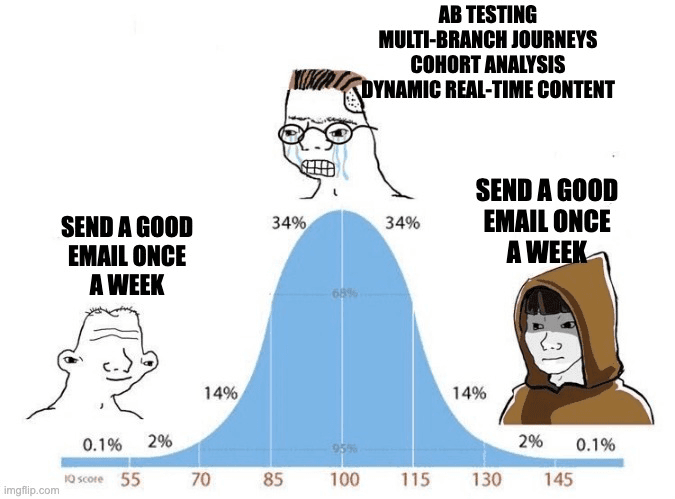
What’s worked better for us is doing less, deliberately.
One audience instead of many.
One clear idea per email.
Writing as if we’re speaking to a single, real person — not a segment.
Many smaller and more successful teams I’ve spoken to have stopped obsessing over (often misleading) dashboards. They’ve started paying more attention to replies, conversations, and moments where someone references an email of theirs in conversation.
Those signals are harder to track, but they’re far more human. And they can be far more encouraging.
As I touched on last week, you might also want to design your email plans to expect imperfect weeks, not ideal ones.
If a system only works when everyone is motivated and well-rested, it won’t last. Sustainable systems assume you’re busy, human, and occasionally behind — and still let you show up.
Don’t be like everyone else
“Best practice” isn’t universal. It’s contextual.
The best email strategies are built to fit the people behind them, not to impress industry experts.
If this ever made you feel like you’re doing email wrong, you probably aren’t.
You’re just building something real, under real constraints.
The newsletter for purpose-driven marketers
Join hundreds of marketers getting weekly insights on ethical email marketing, sustainable growth, and responsible digital practices.
Unsubscribe anytime. No spam. No nonsense.