Provide a privacy policy
You need to provide us (and your audience) a valid privacy policy before you can start to send emails with EcoSend.
This isn’t just a procedural step, it’s a critical requirement grounded in legal compliance, transparency, and responsible data use.
In this article, we'll dig into why this requirement exists and how you can easily create a privacy policy if you don’t already have one.
Why you need to provide a privacy policy
1. Legal compliance with data protection laws
Email marketing inherently involves collecting and processing personal data (such as names and email addresses). Because of this, businesses must comply with global privacy regulations such as:
- GDPR (Europe)
- CCPA/CPRA (California)
- Various U.S. state privacy laws and international equivalents
These laws require organisations to clearly disclose how they collect, use, store, and share personal data.
A privacy policy is the primary way to provide this information. Without one, businesses may fail to meet legal obligations and risk penalties, legal action, or account restrictions.
2. Be transparent with your audience
A privacy policy is not just a legal document, it’s a transparency tool.
It explains:
- What data you collect
- Why you collect it
- How it is used and stored
- Whether it is shared with third parties
By clearly communicating this, you ensure your audience understands how their information is handled.
3. Build trust and credibility
Trust is critical in email marketing. If recipients don’t feel confident that their data is handled responsibly, they are less likely to engage—or even stay subscribed.
A well-written privacy policy:
- Demonstrates professionalism
- Builds credibility
- Reassures subscribers
- Supports higher engagement rates
4. Industry best practice
Many digital platforms (including payment providers, advertising networks, and SaaS tools) require users to have a privacy policy before using their services.
This is because:
- Platforms share responsibility for data protection
- They must ensure their users comply with applicable laws
- It reduces risk for both the platform and its users
EcoSend follows these same best practices by ensuring all clients meet a baseline standard before sending campaigns.
5. Protect both you and EcoSend
Requiring a privacy policy is also about risk management.
Without proper disclosure:
- Users may file complaints or unsubscribe at higher rates
- Regulators may investigate data practices
- Campaign deliverability and sender reputation may be impacted
A privacy policy helps demonstrate accountability and responsible data handling.
How to create a privacy policy
If you don’t already have a privacy policy, the good news is that creating one is pretty straightforward.
Use a privacy policy generator
There are many free tools that guide you through a series of questions and generate a compliant policy:
- Termly
- Iubenda
- PrivacyPolicies.com
- Shopify Privacy Policy Generator
Legal templates
If you prefer more control, you can use a template-based solution — essentially you get an off-the-shelf template that you can then customise yourself:
- Rocket Lawyer
- LegalZoom
These offer more detailed customisation and may include legal review options.
Work with a legal professional
Ultimately, the safest and most reliable option is to work with a professional.
If your business operates internationally, handles sensitive data, or has complex data flows, this is likely the best option for you.
It’s always worth consulting a data protection or privacy lawyer to ensure full compliance.
Key elements to include in your privacy policy
Regardless of how you create it, your privacy policy should cover:
- What personal data you collect
- Why you collect it (legal basis)
- How you use and store it
- Third-party sharing (if any)
- Data retention periods
- User rights (access, deletion, etc.)
Where to add your privacy policy
Once you have your privacy policy ready, sign in to EcoSend and head to Current Project -> General Settings
From here, scroll down to the section Privacy Policy and insert your URL.
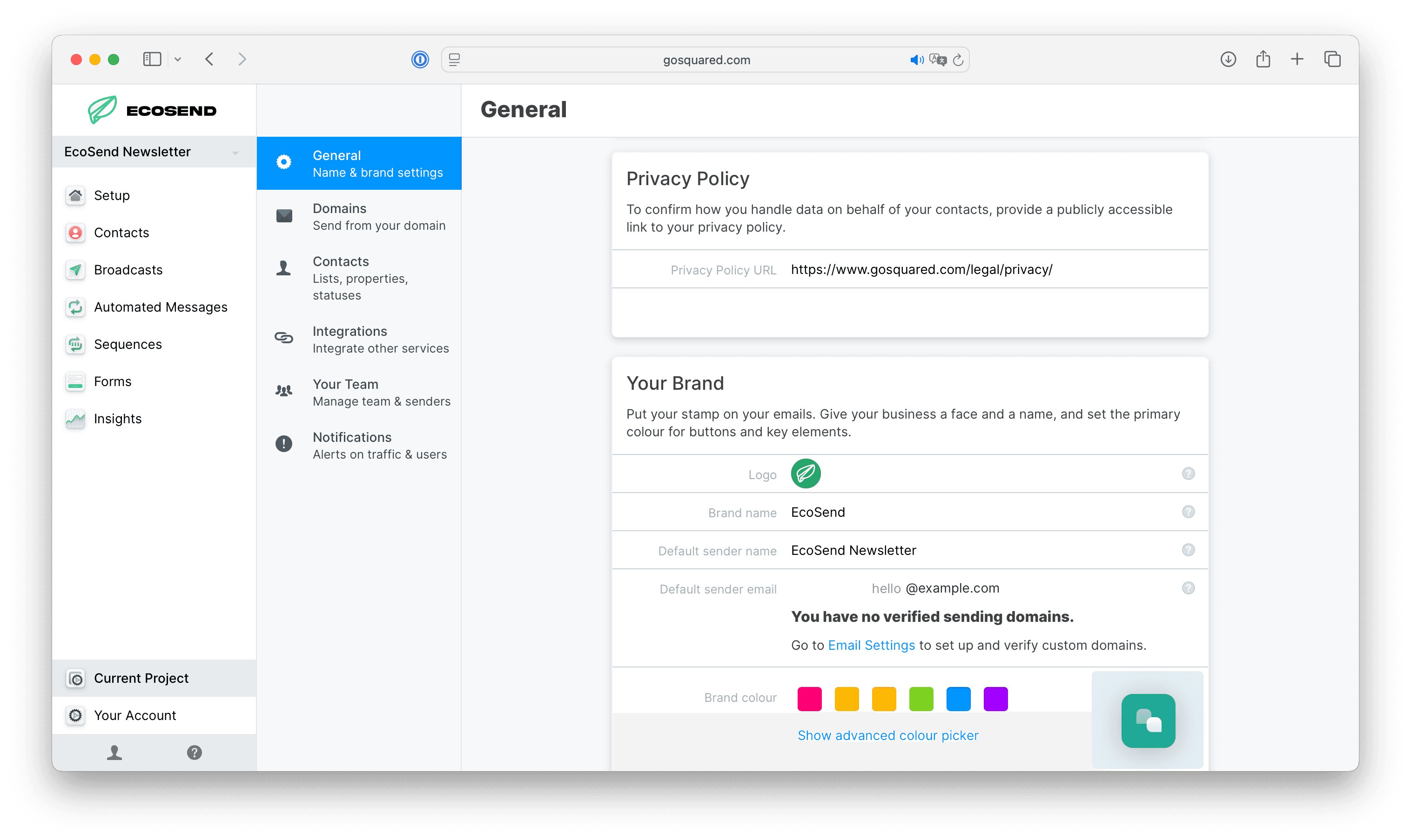
Once you've added your privacy policy, verified your domain, and completed all of the required steps on your account, you will be ready to send your first email campaign with EcoSend.
If you have any issues in creating or providing your privacy policy, reach out to us directly and we'll be more than happy to assist.
Last updated May 2026